How long does nicotine pouch withdrawal last?
Cravings can start within an hour or two of the pouch you would normally have had. Withdrawal is at its worst during the first three days, and the intensity drops over the first month.
Cravings last longer than the physical symptoms. For most people they keep showing up for one to three months, but they get shorter and rarer, and they attach to specific moments rather than running all day.
That is the short version, and for most people it is close enough to plan around. What follows is the timeline stage by stage, what makes yours longer or shorter than average, and the parts that are specific to pouches rather than to smoking.
The timeline, stage by stage
- First hours It starts Nicotine clears the body quickly, and the first craving can arrive within an hour or two of the pouch you would normally have had — not at some point the next day. Early signs are restlessness, reaching for the tin out of habit, and difficulty settling into a task.
- First 3 days The peak Almost everyone describes this as the hardest stretch. Irritability, poor concentration, a short fuse, disturbed sleep and frequent cravings all tend to land together. It is also when most people go back to pouches — usually because they expected it to get steadily easier, and instead it got worse before it got better.
- Days 4 to 14 The climb down The worst is normally behind you by day four. Mood and sleep start to settle, and cravings become episodes rather than a constant background. Appetite often increases in this window. This is the stretch where people say they feel "mostly normal, with bad half-hours".
- Weeks 2 to 4 Physical withdrawal fades For most people the intensity has dropped away by the end of the first month. Sleep is usually back to normal. What is left is habit rather than chemistry. Some people do report symptoms for longer, which is normal rather than a sign of failure.
- Months 1 to 3 The habit outlasts the withdrawal Cravings get rarer and shorter, and they stop being random. They arrive with coffee, with driving, after a meal, at the end of a work session — wherever a pouch used to go. Knowing your own triggers matters more than willpower by this point.
Why days 2 and 3 matter more than the rest. If you know in advance that the middle of the first week is the peak and not a sign that something has gone wrong, you are far less likely to read it as failure. Most relapses in the first fortnight happen on a day people expected to feel better than the one before.
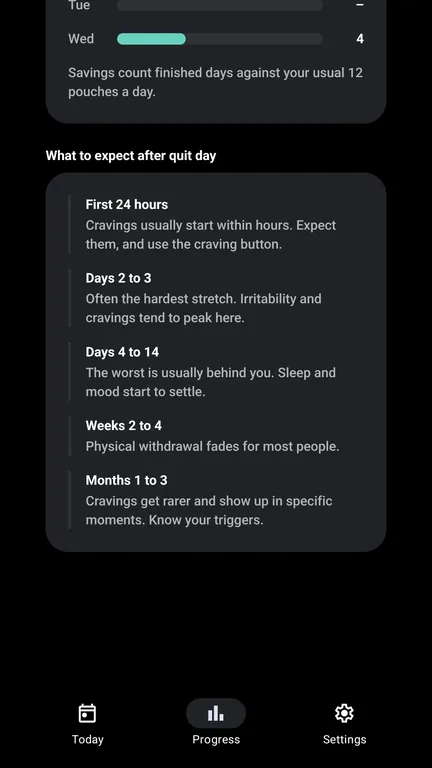
These are the same stages inside the Lastlid app. The point of having them on a screen you can open is that "is this normal?" becomes "which stretch am I in?" — a question with an answer.
The app counts from your last pouch rather than from the date you meant to stop, which matters if quit day did not go exactly to plan.
What makes your timeline longer or shorter
The stages above are the common pattern. Three things move them:
- How long you have used pouches. A few months of use is a shorter and milder withdrawal than several years. Length of use tends to matter more than the exact daily count.
- How many you use a day. Ten or more a day means more nicotine and, just as importantly, a habit wired into more moments of the day.
- The strength you use. A 3 mg pouch and an 11 mg pouch are not the same habit. Strength has been climbing across the category — products at 9 mg and 11 mg are now common where 3 mg and 6 mg used to be the norm — and heavier doses generally mean a heavier withdrawal. (What the number on the tin actually means.)
Sleep, caffeine and stress all sit on top of this. A bad week at work does not change the chemistry, but it changes how much spare capacity you have to get through it.
What pouches do differently
Most withdrawal advice you will find is written about cigarettes, and it mostly transfers. Two things do not:
Pouches are invisible, so the habit is wider. You cannot use a cigarette in a meeting, on a flight or in bed. You can use a pouch in all three. That means the habit attaches to far more moments of the day than smoking does, and when you stop, more of your day has a gap in it. People are often surprised that the cravings are not worse but more frequent.
There is no smoking-related relief to look forward to. People quitting cigarettes usually notice breathing, taste and smell improving within days, which is a reward that arrives early. Quitting pouches has fewer obvious physical wins in week one — the improvements people report are mostly gum comfort, sleep and not being tied to a tin. It is worth knowing this in advance so the absence of a dramatic change does not read as "this is not working".
How solid is this? Nicotine pouches are new enough that there is far less published research on quitting them specifically than there is for cigarettes or snus. The timeline above reflects the well-established pattern of nicotine withdrawal and what pouch users consistently report. Treat it as a map, not a measurement — yours can run a few days either side of it.
Common symptoms
Not everyone gets all of these, and most fade inside two weeks:
- Cravings, strongest in the first three days
- Irritability and a shorter temper than usual
- Trouble concentrating, or a foggy feeling
- Restlessness and difficulty sitting still
- Disturbed sleep, vivid dreams, or waking early
- Increased appetite, often for sugar
- Low mood, usually mild and short-lived
- Mouth and gum sensations changing as the tissue recovers
Symptoms that are severe, or a low mood that deepens and stays rather than lifting over a couple of weeks, are worth taking to a doctor rather than waiting out.
The shape of this timeline — cravings within an hour or two, worst in the first three days, intensity dropping over the first month, occasional cravings much later — follows the National Cancer Institute's description of nicotine withdrawal. That description is about tobacco use generally; what is specific to pouches is marked as such above.
Tapering changes the shape of this
Everything above describes stopping outright. Stepping down instead spreads the same withdrawal over several weeks: each week you meet a smaller version of it rather than all of it on one day. The peak is lower, but the process is longer — typically four to six weeks before quit day, and the timeline above still runs from the last pouch you take at the end of it.
Neither approach is better for everyone. Stopping outright is shorter and sharper. Tapering suits people who have tried before, stopped dead, and gone back inside a week. Longer comparison of the two.
Free, no sign-up, and nothing you type leaves your browser.
Questions people ask
Does nicotine pouch withdrawal cause headaches?
Headaches are a common early symptom, usually in the first few days, and they typically pass with the rest of the acute phase. Dehydration and a change in caffeine habits often make them worse, so both are worth watching in the first week.
How long until the cravings stop completely?
For most people cravings are rare by the three-month mark rather than gone. Occasional ones can turn up much later, usually attached to a specific situation — a particular bar, a stressful deadline, the first coffee of a holiday. They are short, and they do not mean the quit is unravelling.
Is pouch withdrawal worse than cigarette withdrawal?
Not usually worse, but often more frequent, because pouches can be used in far more situations than cigarettes. The chemistry is the same nicotine dependence; the habit is wired into more of your day.
Will cutting down first make withdrawal easier?
It spreads it out rather than removing it. A taper gives you a lower peak and a run of small wins, at the cost of a longer overall process. What matters more than the method is having a quit date and a number for today, so that "cutting down" does not quietly become "using slightly fewer forever".
Does the strength of the pouch change the timeline?
It changes the intensity more than the shape. The stages arrive in the same order whether you use 3 mg or 11 mg pouches, but a heavier dose generally means stronger cravings in the first week. Stepping down through lower strengths before quitting is one way to lower that peak.